
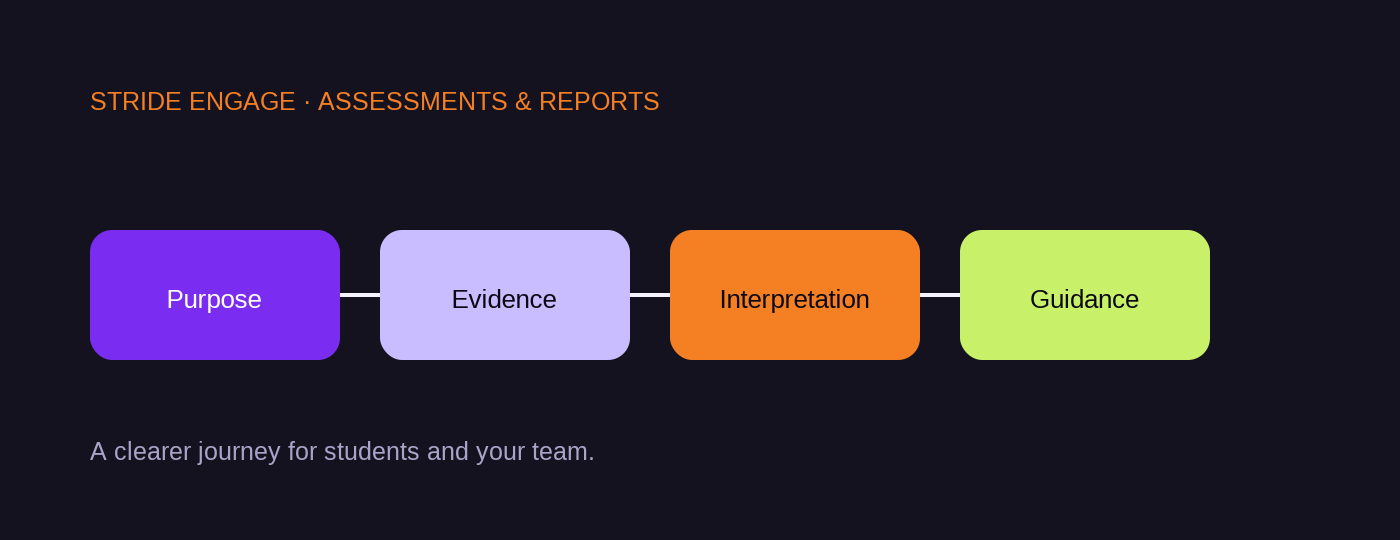
Ask what the assessment measures, what evidence supports the intended interpretation, who the evidence applies to and how a practitioner should explain the result. A polished report can help a student understand information, but its design does not establish that the underlying assessment is appropriate for your programme.
For an institution or counselling venture, choosing a report is also a delivery decision. Your team needs to know what it can responsibly say, what questions require interpretation and what students should do after reading it. Those requirements deserve as much attention as the sample PDF.
What is the assessment intended to measure?
Begin with a plain description of the construct and purpose. An interest questionnaire asks about preferences for activities. An aptitude assessment samples performance on particular tasks. A personality instrument addresses another set of questions. Request an explanation that keeps those ideas distinct.
The O*NET Interest Profiler, for example, describes itself as a career exploration tool that helps people investigate work activities and occupations connected to their interests. That is a useful example of stating a purpose. It is not evidence that a different assessment has the same properties.
Ask the provider to explain each score in the report. If a number is labelled a match, find out what was combined to calculate it and what the result permits you to conclude. Do not assume that a percentage is a probability of career success.
What evidence should the provider make available?
Request the technical documentation relevant to the assessment version and the way you plan to use it. Ask about reliability, validity evidence, the development sample, administration conditions and known limitations. The answer should help you judge the proposed use rather than present a general claim that the instrument is scientific.
The International Test Commission's guidance on test use calls for evidence of reliability and validity for an assessment's intended purpose. This is a general principle of responsible test use, not a certification of any product mentioned here.
A familiar theory does not remove the need to examine the particular instrument. Ask how the questions, scoring and interpretation were developed. If a provider cites another test's research, ask which parts apply directly to the assessment your students would take.
Who is represented in the reference group?
Ask which learners contributed to the norms or comparison data and whether that group is relevant to your students. Age, language, educational experience and administration conditions can matter when interpreting a comparison. The provider should explain the boundaries of the available evidence.
A percentile needs a named reference group. It should not be read as the percentage of questions answered correctly, nor as a student's permanent position among all learners. Ask for an explanation your practitioners can use consistently.
If the intended group differs from the group studied, discuss the implications before purchase. The appropriate answer may involve a different instrument, a narrower interpretation or further evidence. A provider's confidence is not a substitute for that discussion.
How are interests, aptitude and engagement kept separate?
The report should make the distinction visible in both wording and layout. A student might explore a field frequently while still learning its foundational skills. Another may perform well on a task without wanting to pursue the associated work. Both are reasonable starting points for a conversation.
Platform activity belongs in a separate category. Opening reports, saving courses and returning to a dashboard can describe participation. Those actions should not silently become evidence of cognitive ability or a psychological trait.
Ask to see a sample explanation of a profile with mixed results. A useful interpretation should preserve that complexity and suggest questions to investigate. It should not force every result into a single career label just to make the report look decisive.
What should a practitioner be able to explain?
A practitioner should be able to explain what a score means, what it does not mean and how it connects to the student's question. Ask what training, manuals and support are available, and which interpretations require particular qualifications.
During a demonstration, choose a sample page and ask the provider to talk through it as they would with a student. Then ask what they would say if the student disagreed. This reveals more about the usefulness of the report than a tour of chart styles alone.
Plan how students can ask questions after receiving their results. A downloadable document is convenient, but a difficult interpretation should not be left to guesswork. Decide whether follow-up happens through a group discussion, an appointment or another supported route.
Can a report include the institution's own services?
It can introduce a relevant programme or guidance option, provided the commercial offer is clearly distinguishable from the assessment findings. A student should be able to understand their report without being told that buying another service is the necessary response to a result.
Review how your logo, programme page and booking destination will appear. Check the destination on a phone, confirm the service description and make sure someone owns the response when a student enquires. Treat those checks as part of the delivery process.
If report engagement is tracked, ask what an open or click actually records. Use that information to understand interaction with the report. Do not present it as evidence that the assessment changed a student's decision or improved an outcome.
What should you do before choosing a provider?
Write down the decision your programme is trying to support, the student group and the people who will interpret results. Request a sample report, the relevant technical documentation and an explanation of limitations. Review these together, rather than selecting a report because one page looks impressive.
Pilot the delivery process with an appropriate group and clear permissions. Evaluate whether instructions were understandable, results could be explained and students knew how to get help. Keep your operational observations separate from any claim that you have established psychometric validity.
Where can you inspect the Stride Engage report experience?
View the sample report gallery to inspect presentation and the connection to follow-up guidance. Sample pages show the reading experience. Ask for the documentation appropriate to the assessment, student group and use you are considering before making an adoption decision.
Sources
O*NET Resource Center: Interest Profiler, accessed 11 November 2026.
International Test Commission: Guidelines on test use, accessed 11 November 2026.