
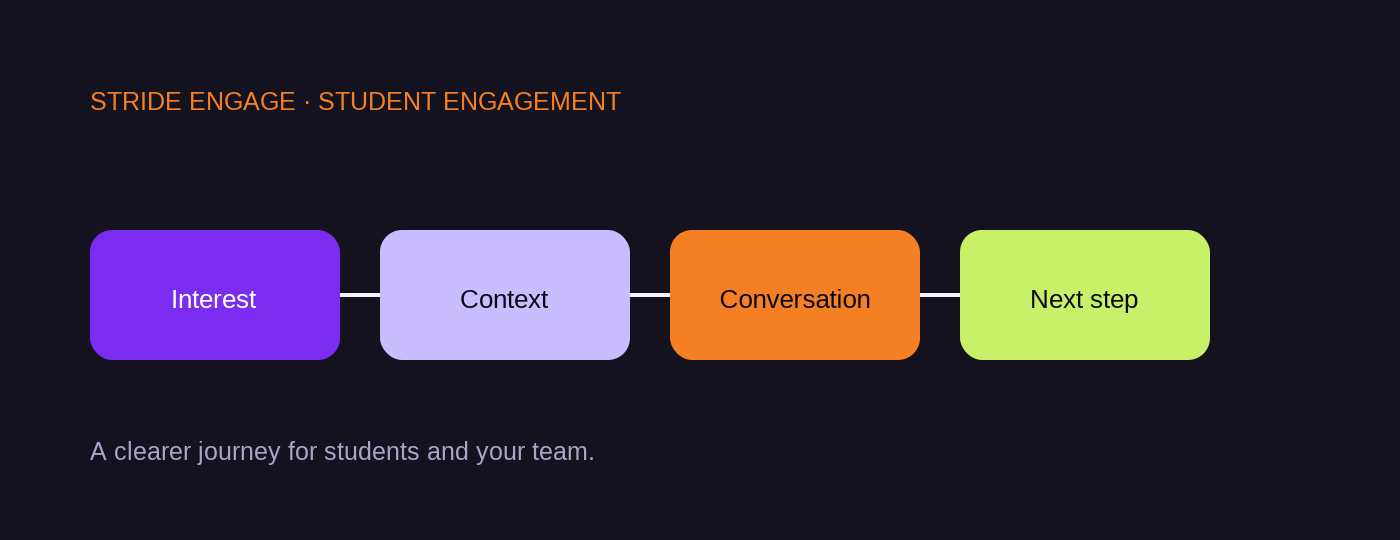
A useful student follow-up starts with a question the student is trying to answer. It connects a recent conversation or activity to a relevant next step, gives the student a clear choice and leaves room for them to say they are not ready. Sending more messages is not a substitute for understanding what someone needs.
This matters for counselling practices, study-abroad ventures and institutions offering their own programmes. The team needs a workable way to remember each student's context. The student needs a reason to respond that goes beyond another request to book a call.
What context is actually useful?
Start with what the student has told you: their current question, the options they are considering and any practical constraints they want help with. Keep that separate from observations such as viewing a report or saving a course. A stated goal and a click are different kinds of information.
A short, dated note can make the distinction clear. Record that the student asked about course prerequisites, for example, rather than labelling them highly interested because they opened a page. If their plans change, update the note instead of letting an old assumption shape every later message.
Collect information because it supports the service you provide. More fields do not automatically produce a better conversation. Decide which details the team needs to see and how they will be kept current.
What can activity tell the team?
Activity can suggest a question worth asking. It cannot reliably tell you why the student took an action. Someone may open a scholarship page for themselves, for a friend or simply to understand what is available. Several visits to a course page do not establish that the student can afford the course or meets its entry requirements.
Use an observation as an invitation to clarify. A message could ask whether the student wants help understanding eligibility. It should not announce that your team has decided which service they need.
For the same reason, an engagement score belongs alongside its context. It is not an aptitude score, a readiness judgement or a measure of someone's ability to pay. Keep those concepts distinct when designing the team's view.
How should a follow-up message be written?
Name the question, explain what help is available and offer one practical action. A suggested message after a course discussion might be: “You mentioned that entry requirements were unclear. We can look at those together before you narrow your list. Would a short conversation help?”
That is an illustrative wording, not a customer quote or a message generated by the platform. It gives the recipient enough information to decide whether the conversation is useful. It also works without listing every item they have viewed.
Avoid invented urgency. If a scholarship or event has a genuine deadline, check it at the original source and give the date. If there is no deadline, let the value of the next step carry the message.
When is it appropriate to introduce a paid service?
Introduce a paid service when its scope addresses a need the student has expressed, and make the commercial nature of the offer clear. A student trying to understand an assessment report may value an interpretation session. Someone who only wants to explore occupations may prefer to continue independently.
Explain what the service includes, what it costs and what the student will receive. Do not use an assessment result to suggest that a purchase is necessary to avoid failure. A recommendation should be understandable without a claim that the platform knows the student's future.
This creates a plausible route to incremental revenue, but the outcome depends on the offering, its quality, price and student demand. A contextual placement is an opportunity to make a relevant service visible. It is not a forecast of sales.
How can the team avoid duplicate conversations?
Keep a concise record of what was discussed, the agreed next action and when it should happen. Before contacting someone, check whether a colleague has already answered their question. The point of shared context is to continue the conversation rather than restart it.
Separate an open question from a general activity signal. A student waiting for clarification needs a response. A student browsing independently may need no intervention. Treating both as the same follow-up task fills the team's list with work that has no clear purpose.
Review old notes as well as new activity. A follow-up that made sense before an appointment may no longer be relevant after it. Give the team a way to record that the issue was resolved.
What should you measure first?
Start with whether promised responses happened and whether students found the next step useful. Track the number of unresolved questions, completed conversations and repeat enquiries about the same issue. Define the reporting period and the group being counted so your figures can be interpreted.
If you also track service uptake, keep it separate from engagement. A student can gain value from a conversation without buying anything. A booking can happen for reasons unrelated to the latest message. Avoid claiming that a campaign caused an increase simply because the two occurred together.
Use the results to improve the service. If students repeatedly ask what an appointment includes, clarify the booking description. If follow-ups pile up, review capacity and responsibility before increasing message volume.
What can you change this week?
Review one recent activity and the follow-up it currently triggers. Ask whether every participant receives the same message and whether that message answers a question they actually have. Replace a generic instruction with a clear invitation to a relevant next step.
Then review a small set of open conversations with the team. Agree what has been answered, what still needs attention and which student should simply be given space to explore. This is an operational suggestion to try and evaluate, not a promised improvement in enrolment.
How does Stride Engage show this approach?
See the institution view for an illustrative example of interests, activity, separate assessment and engagement scores, and context for a follow-up. The example uses fictional records to show the intended experience; discuss the workflow your team needs in a demonstration.
Sources
This article proposes an operational approach. It makes no numerical claim about conversion, retention or customer results. For broader career-programme context, see OECD: Career guidance, accessed 11 November 2026. The OECD material does not validate a sales process or endorse Stride Engage.